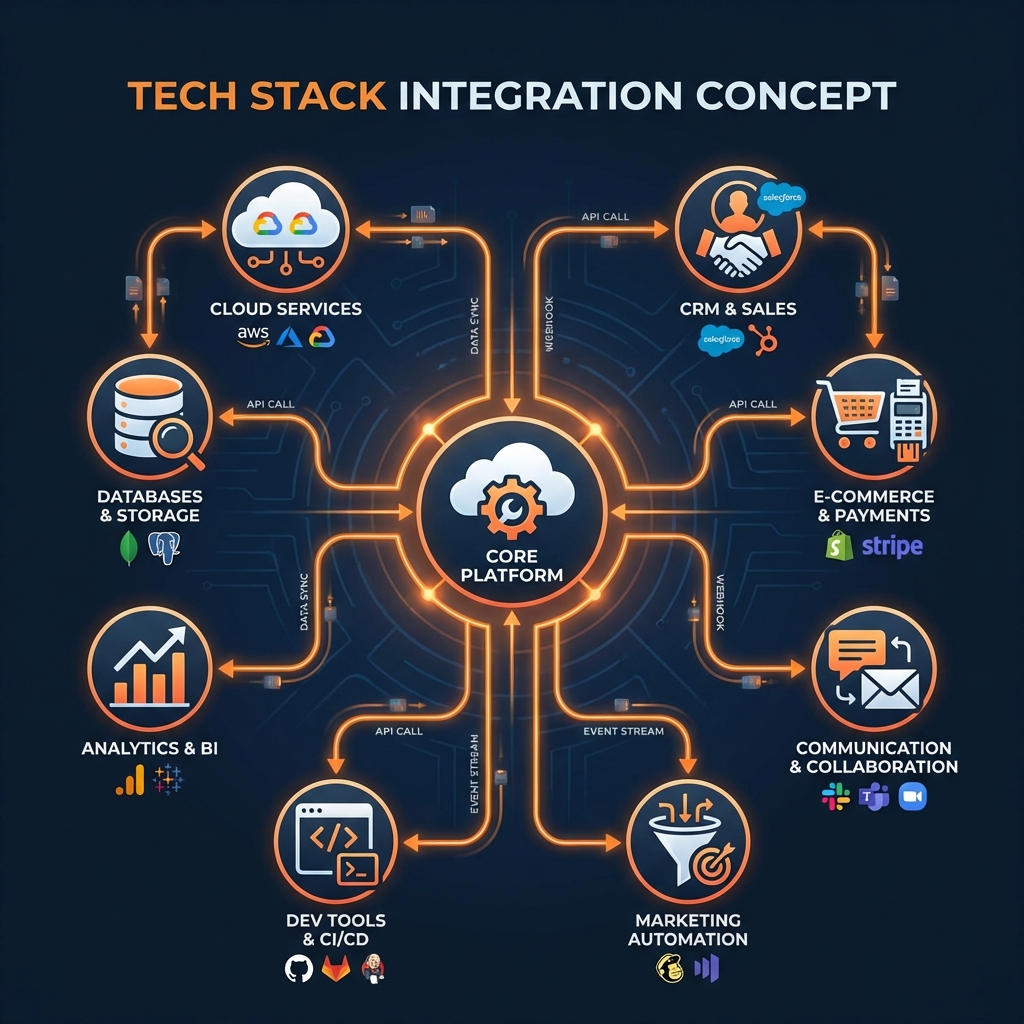
The average small business uses 40+ software applications. For mid-sized companies, that number often exceeds 100. Each tool was probably selected to solve a specific problem—but now you have data scattered everywhere and staff manually bridging the gaps between systems.
The Data Silo Problem
When your CRM doesn't talk to your accounting software, and your project management tool doesn't sync with your billing system, you create information silos. Staff waste hours hunting for data and manually copying it between systems—introducing errors and delays at every step.
Why "Native Integrations" Fall Short
Many software vendors advertise integrations with other popular tools. But these native integrations are often limited—syncing only basic data fields, lacking customization options, or requiring expensive premium tiers. They rarely handle the specific workflows unique to your business.
The API Alphabet Soup
For deeper integrations, you need to work with APIs (Application Programming Interfaces). But API quality varies wildly: some are well-documented and reliable, others are poorly maintained or have restrictive rate limits. Even experienced developers struggle with the inconsistencies.
Real-Time vs Batch Processing
Should data sync instantly or in scheduled batches? Each approach has trade-offs involving complexity, cost, and reliability. The wrong choice can leave you with stale data or overwhelmed systems—problems that aren't obvious until you're in production.
Error Handling and Recovery
What happens when an integration fails? Without robust error handling, you might not even know data didn't sync. Building reliable integrations means planning for failures—network issues, API changes, rate limits, and data validation errors.
The Maintenance Reality
Integrations aren't "set and forget." APIs change, software updates can break connections, and business requirements evolve. Without ongoing monitoring and maintenance, integrations that once worked perfectly can silently start failing.
Building a Connected Foundation
Successful integration requires strategic planning: mapping your data flows, prioritizing which connections matter most, selecting appropriate middleware, and designing for maintainability. It's an investment that pays dividends in efficiency and accuracy.
Ready to Connect Your Systems?
We specialize in building reliable integrations that unify your tech stack and streamline your operations.
Book a Free Consultation